North Dakota summers feature significant hatches of Aedes vexans and Culex tarsalis mosquitoes, fueled by Red River seasonal water levels, agricultural runoff ditches, and dense neighborhood tree canopies. Properties…
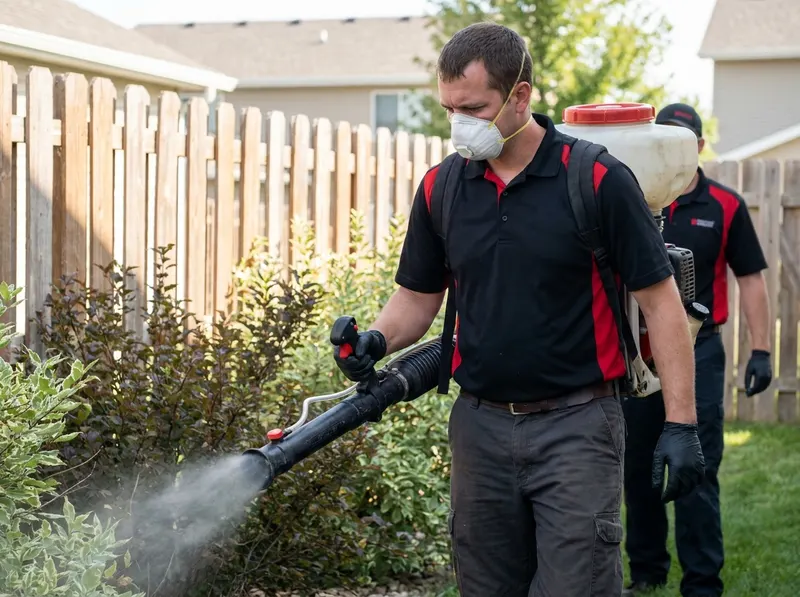
North Dakota summers feature significant hatches of Aedes vexans and Culex tarsalis mosquitoes, fueled by Red River seasonal water levels, agricultural runoff ditches, and dense neighborhood tree canopies. Properties in Hawthorne and Downtown Fargo near Island Park face heavy riverbank shelter pressure, while newer developments like Osgood and Woodhaven battle retention ponds and expansive drainage swales. Superficial lawn sprays fail because adult mosquitoes roost on the undersides of broadleaf foliage, perimeter windbreaks, and deep within shaded foundation plantings. Tactical suppression directs microencapsulated barrier materials into these exact daytime resting shelters, creating a lethal perimeter shield that degrades residual biting populations over multiple weeks.
Larval management serves as the structural foundation for long-term population reduction in Cass County. Retention basins near Bluemont Lakes and decorative water hazards through Rose Creek or Prairiewood harbor active breeding nurseries whenever standing water persists past 96 hours. Technicians apply targeted Bacillus thuringiensis israelensis (BTI) larvicides to non-potable water aggregations, neutralizing larvae before pupation without compromising non-target organisms. For standard residential parcels under 0.5 acres, continuous 21-day barrier cycles maintain active suppression through the peak freeze-thaw transition down to the autumn frost, whereas large acreage perimeter runs near the Fargodome or Hector International Airport corridor prioritize windward vegetation breaks and heavy ditch lines.
Choosing between one-time event applications and recurring seasonal rotations depends directly on property perimeter exposure. A single-event misting suppresses existing adults for 48 to 72 hours for outdoor gatherings, but lacks the cumulative residual barrier needed to stop re-infestation after heavy summer rains. A full-season perimeter rotation provides continuous suppression, sustaining active insecticide boundaries from May through September. The trade-off centers on upfront expenditure versus re-infestation vulnerability: single treatments address an immediate localized event, while recurring scheduled barriers eliminate breeding succession and prevent vector populations from crossing boundary lines into human activity zones.
Every job gets a firm, written price after a free on-site visit.
Tell us about your mosquito control job in Fargo and we'll send a clear, written quote, usually the same day.
 Trivano Bug Response